


In this modern era of a digital-first lifestyle, the average professional, student, gamer, and other people spend much time at the computer monitor daily. It would be true that as much as technology gives us power, it comes with its health problems when the workstations are not ergonomically engineered. Inadequate monitor placement is one of the most widely spread problems and may cause chronic neck and back pain, the stiffening of the shoulder muscles, and eye fatigue.
It is in this case that monitor stands come in handy. These accessories will help in designing an ergonomic workstation because they will raise your display to the right level and eliminate discomfort, and increase productivity. However, besides mere elevation, the modern designs also encompass numerous capabilities, including cable management, storage, and complete articulation.
This guide goes into deep detail about why eye-level viewing is important, outlining what you should look at when making a purchase, the various types, a review of the best monitor stands, and tips on setting it up to ensure maximum comfort.
Why You Need Eye-Level Viewing
Ergonomic studies have always found that the cross of the prolonged misalignment between your line of sight and the position of your screen results in muscular strain. The normal human would bend the neck at 10-30 degrees when staring at a low screen. With each inch of forward tilt, the spine subjects itself to greater strain, up to the equivalent of a 10–12-pound weight! Eventually, this posture leads to what is termed tech neck by experts.
Adjust your monitor so that it is at eye level; this way, your eyes will be at the top third of the monitor. This centred head posture works well in keeping the spine in twelve bones, keeping muscle stress to a minimum, and staying comfortable even after prolonged use of the computer. Over time, the minor change of using a stand will be able to eliminate chronic pain and even cut down on healthcare expenditures meant to correct posture problems.
Productivity and Health Advantages
The effect of ergonomic enhancements is not only to be noticed in terms of comfort, but it also directly affects performance. Employees who work with properly positioned screens find it easy to get such claims as fewer headaches, fatigue reduction, and increased efficiency. In a 2023 ergonomic survey, it was discovered that employees who work with eye-level monitor stands were 25 percent more productive when compared to their counterparts with misplaced screens.
General Advantages of Using a Height-Adjustable Monitor Stand
- Better Posture – Helps keep spine, neck, and head in neutral position and avoid slouching.
- Less Eye Strain – Eye exhaustion and straining are reduced by proper positioning to reduce glare.
- Increased Concentration and Productivity – Good working postures will enable you to stay focused without distraction.
In addition to their health optimization, a good number of the modern monitor stands offer extra workspace alignment. Integrated tray, drawers, or cable channels, included in models, minimize clutter on the desk, making it look clean and professional.
Aspects That Characterize a Good Stand
There is no equality between all the options, and the contrast between a high- and low-quality accessory is substantial. The most important insurance features to be considered are:
1. Height Range
It is important that a large vertical range can be adjusted. The vertically challenged might not want stands that elevate the screen much more than 8–10 inches, and taller persons might need finer adjustment without going above their eye level.
2. Stability and Carrying Load
Certain models, especially larger 27-inch or 32-inch screens, are heavier. This weight cannot allow a stand to wobble. Most dependable constructions are of heavy-duty, either steel or aluminum.
3. Adjustability Beyond Height
In many models, there is the provision of tilt, swivel, and rotation, besides height. These characteristics enable you to alternate between portrait and landscape settings or the use of an angle to lessen sun and light glare through windows.
4. Durability and Build Quality
The plastic models can be cheap but, in many cases, not durable. High-grade designs are made of aluminum alloy and reinforced connections to be long-lasting.
5. Design and Aesthetics
As the accessory will be part of your working environment, its aesthetics will count. Clean, simple designs can fit in with any cutting-edge environment, whereas large designs can monopolize a smaller workspace.
6. Cable Management
Integrated clips, covers, or holes on the arm enable cables to be included, saving entangling and keeping a line-free look.
Various Sight-Adjustable Pieces
Designs in the market are also diverse, and each design has appealed to a different preference or use case.
- Riser Platforms – The simplest type, stackable or adjustable legs. Cheap and simple, but not highly flexible.
- Articulating Arms – Clamp-mounted, offering multi-directional adjustments (height, tilt, swivel, rotation).
- Gas Spring Arms – Hydraulic-like precision movement, ideal for frequent screen repositioning.
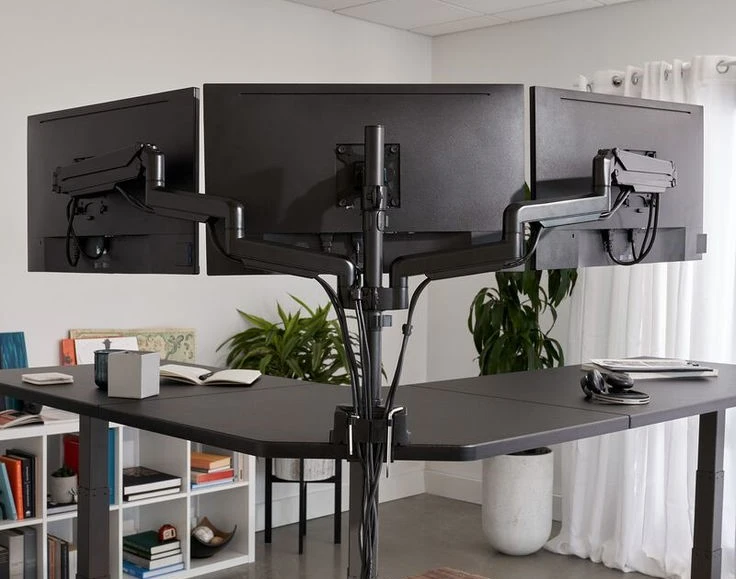
- Dual or Triple Mounts – Great for multitaskers, gamers, and video editors who need multiple screens.
- Wall-Mounted Arms – Space-saving but less flexible than desk-mounted arms.
All of the categories possess their strengths. A student on a budget may desire a platform riser version, whereas a video editor who uses many screens may desire the dual gas spring mount.
Top Adjustable Models Reviewed
This market has options everywhere, but there are certain options that always shine out in their build quality, design, and performance. Five of the most prominent monitor stands are shown below:
1. AmazonBasics Stand
This is an economical stand-up system and is easy to operate. Users can adjust their screen to a higher level in small units. It does not offer sophisticated articulation, and it is suitable for people who do not need aggressive articulation.
2. VO Dual Monitor Arm
Created specifically in mind of those who use two monitors, this stand can be fully articulated, enabling each screen to move independently of the other. It is quite handy to programmers, designers, or traders who need to have several screens at eye level.
3. Ergotron LX Desk Mount Arm
Regarded as something of a gold standard, this model has the combination of high-quality construction and ease of adjustment via a gas spring. It has nice support for heavy monitors, and it can also adjust well so that it can be used at home and in the office.
4. Store and Riser HUANUO
It is a hybrid of elevation and utility. It has storage space beneath the platform to store your pen, notepad, or external drives, so that things do not get messy on the desk.
5. North Bayou Gas Spring Mount
Being the more affordable alternative to Ergotron, this stand grants extreme levels of flexibility, with tilting, rotating, and swiveling. It has solid construction; therefore, it is expected to last long.
Selecting the Best Stand for Your Requirements
- Working Style – Gamers may want smooth adjustability, while office users may want storage options.
- Desk Size – Smaller desks suit clamp-mounted supports; bigger desks work with risers.
- Cost – Premium arms cost more with better flexibility, while risers are inexpensive but basic.
Combining the kind of stand used and your preferred way of life, as well as work environment, helps to achieve efficiency and comfort optimally.
How to Set Up a Chair for the Most Ergonomic Purposes?
Selecting the appropriate model is not the only way; it has to be positioned properly as well. The top of the screen needs to be just slightly below the level of the eyes to motivate a neutral gaze. Have a comfortable distance of 20-28 inches. If you have bifocals, you may lower the screen so that there is less tilt of neck tilt.
Lighting also contributes to it. Board your monitor in areas where there is no direct sunlight (windows) and sudden glare. Calibrate the brightness and contrast to the ambient surroundings so the screen is not too bright.
Complement Ergonomic Accessories
Your stand is most effective when used in cooperation with other ergonomic tools:
- An adjustable chair supports the natural curve of the spine.
- A footrest improves circulation and reduces leg fatigue.
- A keyboard tray positions wrists and arms properly, reducing RSI.
All these accessories can come up with a workstation that enhances sustainable health.
What to Avoid
- Positioning the Screen Too High – Tilting your head up imposes similar pressure as looking down.
- Overlooking Weight Limits. Negligence may occur due to loading a lightweight stand until it begins to wobble and even collapse.
- Inadequate Viewing Distance –Too close or too far results in straining or blurred vision.
These errors can be corrected so as to have the full ergonomic benefit of your investment.
Monitor Ergonomics and the Future
The future of workspace accessories will see seamless integration of technology, including:
- Smart sensors that auto-adjust screen height.
- Internal wireless charging mats and USB ports.
- Green composite building materials.
These improvements will not only alter the degree of comfort but will transform the aesthetic quality of both individual and professional setups as the typical remote work becomes mainstream.
Conclusion
Ergonomics should not be ignored, so a height-adjustable accessory is one of the easiest, yet most effective add-ons. Ranging from riser platforms to sophisticated gas spring arms, there is a model to suit each user, in terms of money and workspace.
It is not too late to enjoy a longer life and avoid the incessant tax load by making good decisions and establishing the right equipment. Monitor stands are more than an office ornament to remote employees, office workers, and avid gamers – indeed, they are a long-term investment in their health and efficiency.
FAQs
-
Does a height-adjustable stand need to be purchased?
Yes. It can prevent posture-related issues and tiredness in cases of spending long periods at a table.
-
Is it possible to use one stand with other monitors?
Designs allow multiple monitor sizes when using a VESA-compatible monitor. Always review specifications.
-
What is superior – desk arms or wall-mounted?
Wall-mounted ones are space-saving but less adjustable, while desk-mounted ones are more versatile.
-
How can I see compatibility with my monitor?
Seek VESA standards such as 75 x 75 mm or 100 x 100 mm on your display.
-
Is it worth the price for gamers?
Absolutely. Proper positioning enhances immersion and reduces strain.