

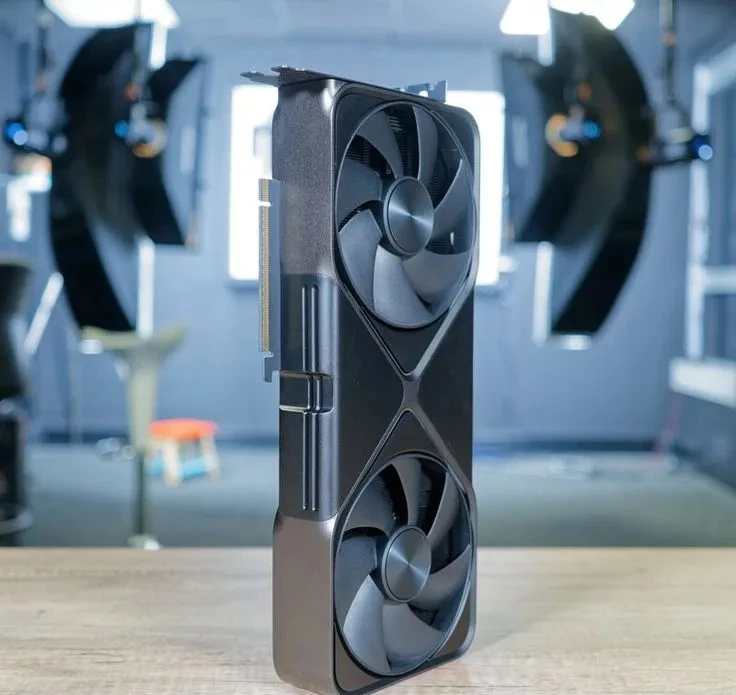
As GPUs increase in performance, NVIDIA has raised the bar originally established in high-performance graphics cards. The RTX 5090 and 5090D are set to follow in the footsteps of the 4K, as well as 8K computing power, real-time ray tracing for gaming experiences beyond immersive and advanced AI-assisted rendering. Despite their power, state-of-the-art technology, an increasing number of users have begun posting reports of serious hardware failures bricking primarily including the front end of “bricking.” This article takes a deep dive into the two most reported RTX 5090 5090d bricked issues, what their signs are actually telling us, how to avoid the fault, and get a smooth recovery route.
The Meaning of a “Bricked” GPU
As stated, there is an article on the InFocus section–a small transducer array imaging company from Austen, Texas. Hardware that has come off a production line, functional but fails to work at all, even after being assembled into complete devices, is referred to as “broken”. Think of it like this – if graphics cards work altogether normally (a.k.a., they boot into their bios and then power up the system with no trouble) but now fail or stop throwing errors, that means not only has their ROM been destroyed.
In addition, some folks may like to know that bricking can be fault-related as well. Software failures are one of the most common reasons for this.
Breaking Bricked with the RTX 5090 and 5090D
Identifying early symptoms could help tell the difference between a temporary glitch and permanent hardware damage. Early examples of rtx 5090 5090d bricked issues include the following symptoms:
- Booting up to black screens
- System failing to POST (Power-On Self-Test)
- Crash of the display driver, followed by a restart loop
- GPU fans are spinning, but there is no output on the display
- Artifacting and either screen freeze or shutdown
- Forgetting that the graphics card is installed
- Disbelieving System BIOS
If you find that any of these situations are happening with your card, then it may be heading towards full brick status.
Most Common RTX 5090 5090D Bricked Issues and Causes
1. Firmware or VBIOS Updates Fail
Flashing a GPU’s firmware or VBIOS is an inherently risky operation. A failed or interrupted flash–whether it happens because the power went out, something about your system’s environment isn’t stable, or some firmware was simply incorrect–will destroy boot instructions on the card.
Users affirmed on various online forums that they had suffered mid-OTA (over-the-air) updates, sometimes prompted by NVIDIA’s GeForce Experience software–a state of complete corruption into which rtx 5090 5090d bricked them. The GPU loses its ability to start correctly during system boot.
Solution:
- Use NVIDIA’s official firmware recovery tools
- Boot with a secondary GPU and try a VBIOS reflash using NVFlash
- Switch to the secondary BIOS if your graphics card has a dual-BIOS
2. Over-Aggressive Overclocking and Tweaking Voltages
The 5090 series from RTX is specifically designed to be high performing, but if you push it too far using over clockers like MSI Afterburner or ASUS GPU Tweak, then the card’s internal settings are thrown out of balance.
Overly aggressive speeds on limits for voltage and memory clock frequency can provide very hard resets or cause thermal runaways, damaging the firmware in an rtx 5090 5090d and resulting in bricked products.
Solution:
- Reset your GPU to factory defaults using BIOS switches or software (if still functional)
- Do not manually control core voltage unless you are proficient
- Benchmark and try settings step by step to find limitations
3. Power Supply (PSU) Deficiency and Breakdown
The 5090 and 5090D rely on a large amount of electricity, often orders of magnitude above 1kW, with multi-pin PCIe Gen 5 connectors. Running it with an inadequate or unstable PSU may produce voltage drops, give brownouts or spikes, particularly when put under high load.
When the GPU fails under high power or fails single-handedly, the computer will overheat and crash. This hassles the user, but also damages his hardware and data irreparably…
The RTX 5090D seems to be the most recent of Nvidia’s products to have bricking problems…
Solution:
- Use only solid-colored wire pairs with proper fastening
- Install adequate coolers and power conditioners
- Upgrade your PSU to match GPU requirements
4. Excessive Heat and Inadequate Cooling
Modern GPUs consume a lot of power, and RTX 5090 does not differ. Extended gaming sessions and AI computing tasks can cause temperatures to reach well over 90 Celsius.. If your card’s thermal management isn’t up to snuff, it may cause protective shutdowns or burn out internal components.
Solution:
- Regularly clean your PC and ensure dust isn’t causing airflow blockage
- Use liquid cooling if possible, especially for custom builds
- Apply high-performance thermal paste and ensure proper heatsink fitment
- Maintain optimal case airflow
5. Driver and Software Conflicts
GPU drivers are constantly developing. While NVIDIA frequently builds in optimizations, the unfortunate truth is that some beta or WHQL-certified drivers may cause system instability. Conflicts with 3rd-party monitoring or tweaking tools only compound the problem.
Solution:
- Use Display Driver Uninstaller (DDU) in Safe Mode to remove all existing GPU drivers
- Install only verified drivers directly from NVIDIA’s official site
- Don’t overlap on GPU software utilities
6. Motherboard Compatibility and PCIe Slot Failures
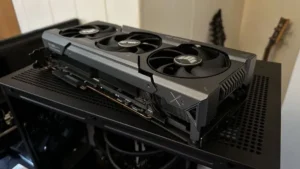
Some motherboards do not completely support the new PCIe slots. Incompatible PCIe slots or an older BIOS may make it hard for the card to talk to the computer.
Solution:
- Update the motherboard BIOS to the latest version
- Try another slot on your mainboard
- Examine the card on an alternative platform to isolate the fault
7. Manufacturing Defects or Early Hardware Failures
As with any new-generation hardware, early adopters occasionally receive units with factory defects…
Solution:
- File an RMA claim through your dealer or NVIDIA support
- If still under warranty, avoid further fiddling
Ways to Prevent RTX 5090 5090D Bricked Issues
- Use a UPS: Protect yourself against unforeseen power outages during updates to firmware
- Check System Health: Monitor temperature, voltage, and fan speed
- No Beta Drivers: Stick with stable releases unless necessary
- Dual BIOS Is Your Friend: Learn how to switch and use safely
- Turn Off Automatic Updates: Turn off the automatic update of the drivers via GeForce Experience
- Normal Series Maintenance: Dust wipes, replace thermal paste, and keep free-flow of air
Restoring a Bricked RTX 5090 or 5090D Video Card
- Attempt Secondary BIOS Mode: Turn off the machine and flip the BIOS switch
- Install an Additional GPU: Boot from another card and attempt recovery via NVFlash
- Use USB Recovery Tools: Try manufacturer-supplied USB recovery kits
- Contact Manufacturer Support: Submit an RMA or support ticket
- Seek Professional Repair Services: Hardware repair labs may reprogram BIOS chips
Community Support Resources
Whether you are experiencing problems with your NVIDIA graphics card or just in need of some community advice, we’ve got you covered with a few trustworthy support options. Subreddits such as r/Nvidia and r/buildapc present voluminous user-generated knowledge, parts of troubleshooting, and other hardware-related discussions. Technical-related forums: Tech Power Up Forums and Overclock.net are great sources of advanced technical discussions, benchmarks, modding tutorials, and advanced diagnostics posted by enthusiasts.
The NVIDIA Official Forums simply open the door to announcements, driver updates, and replies by official support personnel. Also, GPU repair and modding channels on YouTube can become a lifesaver when it comes to step-by-step tutorials and instructional videos about how to fix various issues with your graphics card, whether it has been bricked or is overheating. All these sites make a formidable support system for the new and old users.
Official Acknowledgments from NVIDIA
NVIDIA has acknowledged the problem, as distributed reports indicate some RTX 3090 cards have bricked early on. Suggestions include:
- Updated firmware flashing tools with fail-safes
- A VBIOS hotfix specifically for affected configurations
- Public recommendation to use UPS during firmware updates
Summary
Having RTX 3090 or 3090D cards bricked can make you both frustrated and impoverished. However, by learning to read the signs your hardware gives and respecting software procedures, as well as effective troubleshooting when necessary, this disastrous fate can be averted or even reversed on a dime.
To cope with a dodgy graphics card, do not fear! You can salvage it by following the steps of the recovery process, channeling with communities, and always maintaining the status of your guarantee if seeking manufacturer help.